Blog
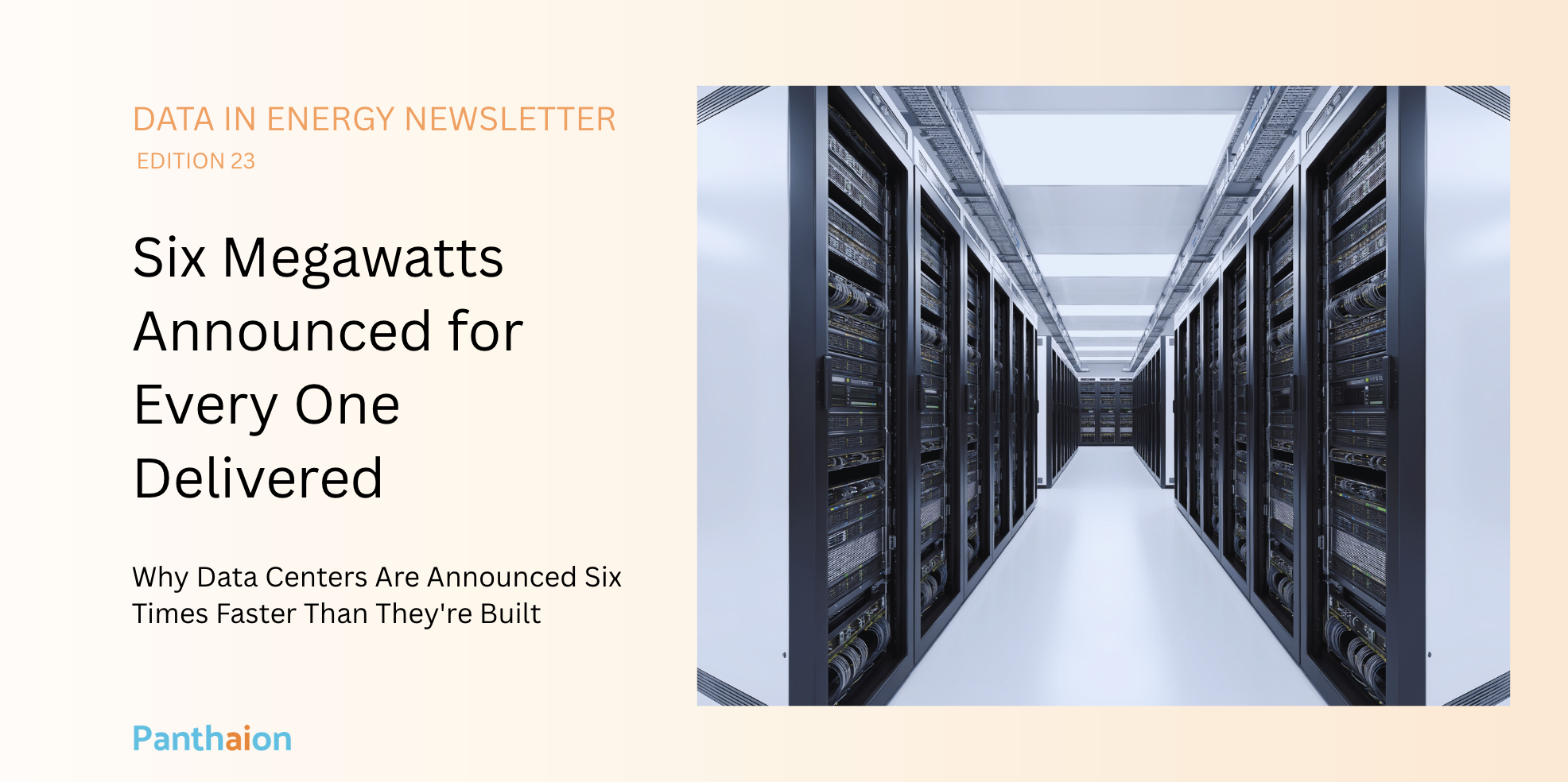
Six Megawatts Announced for Every One Delivered
The best questions are not always the comfortable ones. Like: what happens when the companies buying electricity get tired of waiting for it, and just start generating their own.
Two numbers from this month tell the real story of the AI buildout better than any headline about a new campus groundbreaking. One is a capacity number. One is a price number. Together they explain why the biggest technology companies in the world are quietly turning into power companies.
The Scale Gap
Cleanview's September tracker counts 1,306 operating US data center facilities, representing 61,443 megawatts of live, reported power. Against that, 2,091 additional projects are in the pipeline, representing 380,103 megawatts (source: Mean.ceo). That is roughly six times more capacity announced than is currently running. Announced gigawatts are not delivered gigawatts, and the gap between the two numbers is where most of the actual friction in this industry lives right now.
That gap is easier to see than to describe in numbers alone. We have uploaded the facility-level geospatial data behind the operating side of this ratio to Panthaion, mapping the coordinates, footprint, and operator of nearly 1,500 currently operating US data centers. You can explore or download the dataset directly to see where today's operating capacity actually sits, the baseline against which the 2,091 planned projects above will have to compete for grid connections.
The underlying growth curve explains why the gap keeps widening. US data center electricity demand moved from 23 gigawatts in 2023 to about 42 gigawatts today, with projections putting US power demand for AI at 134 gigawatts by 2030 (source: iRecruit). Interconnection delays of five to seven years are now standard, which means a project announced this year is not realistically drawing power until well into the 2030s, even as the demand curve keeps climbing underneath it.
Where the Gap Becomes a Price
That gap does not stay abstract. It shows up directly in what everyone else on the grid pays. PJM Interconnection, the grid operator covering 13 mid-Atlantic and Midwestern states plus Washington DC, saw its capacity auction price jump 833 percent in a single year, from $28.92 per megawatt-day for the 2024-25 delivery year to $269.92 for 2025-26 (source: IEEFA). PJM's own Independent Market Monitor attributed 63 percent of that increase directly to data center load growth, translating to roughly 9.3 billion dollars in costs recovered from ratepayers across the region (source: Introl).
The following auction, for 2027-28, was worse in a different way. It cleared at the FERC-approved price cap and still fell about 6,625 megawatts short of reliability requirements, the first time PJM has failed to procure enough capacity in its history (source: Introl). Data centers accounted for 94 to 97 percent of the load growth behind that shortfall. Analysts now estimate the average family in PJM territory faces roughly a 70 dollar monthly increase by 2028, with cumulative costs through 2033 potentially reaching 100 to 163 billion dollars depending on whether price caps hold (source: Introl).
The Companies Decide to Become Utilities
Faced with multi-year interconnection queues and capacity prices moving in one direction, the largest AI companies concluded that waiting was not a viable growth strategy. Microsoft signed a 20-year power purchase agreement with Constellation Energy to restart Three Mile Island Unit 1, renamed the Crane Clean Energy Center, securing 835 megawatts of carbon-free power directly rather than competing for grid capacity (source: Tech Insider). Amazon and Meta have pursued similar direct deals with nuclear and gas generators. The pattern is consistent across the industry: rather than treat electricity as something the grid supplies on request, hyperscalers are increasingly building, owning, or contracting dedicated generation the way a utility would.
Regulators have started moving in the same direction from the other side. FERC ordered the six largest US grid operators to fast-track AI data center power hookups within 60 days, with tariff filings due by mid-August determining how the cost of new gigawatt-scale connections gets split between the developer and everyone else on the grid (source: Tech Insider).
Washington's Answer
The clearest sign of how seriously this is being taken came on March 4, 2026, when seven of the largest AI companies, Amazon, Google, Meta, Microsoft, OpenAI, Oracle, and xAI, signed the Ratepayer Protection Pledge at the White House. Under the pledge, signatories commit to build, bring, or buy all the energy their data centers need, fund the power delivery infrastructure themselves, and negotiate separate rate structures so the cost does not land on household bills (source: EPA). By July, the pledge had expanded to more than 300 organizations across governors, utilities, and developers, covering roughly 80 percent of the power delivered to American homes and businesses (source: White House).
The pledge is voluntary, and its real test will run through utility tariffs and state regulatory proceedings rather than federal enforcement, which is exactly where skeptics, including reporting from the Wall Street Journal, have questioned whether it can actually be enforced (source: Perkins Coie). It is, in effect, a bet that the same companies causing the scale gap can also build their way out of it fast enough to keep the promise.
What This Means If You Just Pay an Electric Bill
None of this is abstract if you live inside PJM's 13-state footprint, which covers roughly 67 million people. The 70 dollar a month estimate for 2028 is not a worst case scenario, it is the baseline projection built on auction prices that have already cleared. Even outside PJM, the pattern is spreading. Wholesale electricity prices near some US data center clusters have already risen by as much as 267 percent, and utilities in multiple states are moving to create separate rate classes for hyperscalers specifically because regulators do not trust the existing system to keep those costs off residential bills (source: Introl).
The Ratepayer Protection Pledge is the mechanism meant to prevent exactly that outcome, and it is worth understanding what it actually promises versus what it does not. It does not lower anyone's bill today. It is a commitment that future data center growth will not add to what a household already pays, enforced through hundreds of individual utility rate cases rather than any single federal rule. That means the real protection an average ratepayer gets depends entirely on how aggressively their state regulator holds hyperscalers to the pledge's terms, which is why Virginia, Ohio, and a handful of other states have already moved to write their own rate classes rather than rely on the pledge alone (source: IEEFA).
The practical takeaway for anyone watching their own utility bill is to pay attention to two things over the next year: whether your state has created, or is creating, a separate data center rate class, and whether your utility's next rate case cites AI or data center load growth as a justification for a rate increase. Those are the two places where the scale gap above either gets absorbed by the companies causing it, or passed quietly onto everyone else's monthly statement.
What It Means Going Forward
The scale gap and the hyperscaler-as-utility trend are the same story viewed from two ends. A six-to-one ratio between announced and operating capacity is what happens when demand outruns a grid that takes years to expand. Companies with enough capital to skip the queue are responding by building parallel power systems of their own, and Washington is betting that a voluntary pledge can keep the resulting costs from landing on the people who never asked for any of it. Whether that bet holds is now a five-year forecasting problem, not a policy statement, and it is exactly the kind of question this newsletter exists to keep tracking.
Want to contribute your thoughts or findings in data and AI with climate, energy, or nature? Send us a DM or email to vmarsland@projectcoeus.com.
Sources:
- Data Centers News, September 2026 — Mean.ceo
- Data Center Power & Energy News 2026: Weekly Project Updates — iRecruit
- Projected Data Center Growth Spurs PJM Capacity Prices by Factor of 10 — IEEFA
- PJM $100B Rate Shock: Data Centers vs Ratepayers — Introl
- PJM's 6GW Capacity Shortfall — Introl
- US Grids Get 60 Days to Fix AI Data Center Power — Tech Insider
- President Trump Expands Historic Ratepayer Protection Pledge — EPA
- Ratepayer Protection Pledge — The White House
- White House and Leading AI Companies Commit to Ratepayer Protection — Perkins Coie