Blog
The Super El Niño
The best questions are not always the comfortable ones. Like: what happens to an energy system already under strain from record AI demand when a major climate event arrives that nobody has adequately priced into the planning? And when the data infrastructure that should make that collision visible is fragmented, proprietary, or simply absent, who bears the cost of the gap?
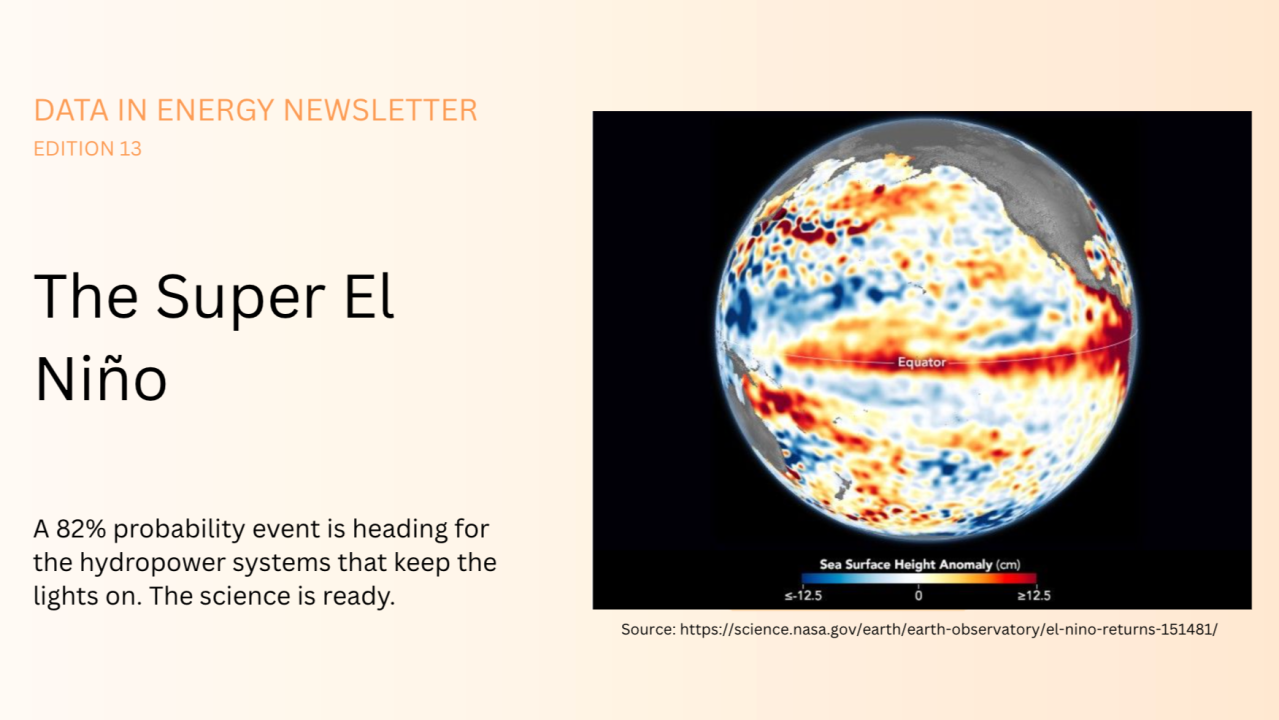
These questions are arriving simultaneously this week. An El Niño event with a 96% probability of persisting through winter 2026 to 2027 is bearing down on hydropower systems that hundreds of millions of people depend on. The grid absorbing record AI electricity demand is the same grid that El Nino will stress. And the monitoring systems that should be tracking both are running behind the physical reality they are supposed to describe.
The Climate Event Nobody Has Priced
An El Niño event now has an 82% probability of emerging between May and July 2026 and a 96% probability of persisting through winter 2026 to 2027 (source: NOAA via Earth.Org). April 2026 was the joint third-warmest April on record at 1.43 degrees above pre-industrial levels, making 2026 virtually certain to rank among the ten warmest years ever recorded and on pace for the top five (source: Copernicus / Earth.Org). The unusual warming of global seas is the hallmark of an emerging El Niño, and several major forecasters have updated their predictions toward a stronger event than initially modelled.
El Niño has specific and well-documented consequences for the energy system. The core mechanism is simple. El Niño shifts rainfall patterns, producing drought in some regions and flooding in others. For countries that generate the majority of their electricity from water, drought means power shortfalls. For countries that depend on hydropower to keep coal and gas offline, drought means increased fossil fuel burn at the exact moment that heat-driven cooling demand is peaking.
In India, a rise in electricity demand from El Niño conditions is expected to raise coal-fired power generation by 10% year on year, while the hydropower capacity the country relies on to fill demand gaps comes under simultaneous drought pressure (source: PreventionWeb). In Zambia and Zimbabwe, El Niño drought conditions previously reduced hydropower generation at Kariba Dam to near zero, triggering rolling blackouts across both countries. The same risk applies across the Democratic Republic of Congo, Mozambique, and Tanzania, all of which depend on hydropower for more than 80% of their electricity (source: PreventionWeb).
The supply chain consequences extend beyond power generation. In Indonesia, where hydropower underpins mining operations, any rainfall shortfall risks curtailing nickel production, affecting global battery and steel supply chains. In Chile, El Niño brings heavy rain that inhibits access to mountainous copper mining regions. Drier El Niño conditions can also restrict maritime traffic, layering a logistics shock on top of an already constrained supply picture (source: ORF Middle East / PreventionWeb).
What Preparation Actually Requires
El Niño is not a surprise. The forecasting science is strong and the lead time is sufficient for meaningful preparation. The problem is that preparation requires data systems and governance structures that most affected countries do not yet have at the scale the event demands.
The minimum requirements are straightforward in principle. Hydropower reservoir levels need to be monitored in real time and shared across regional grid operators so that countries can anticipate generation shortfalls before they become blackouts. Demand forecasting models need to incorporate El Niño temperature and humidity projections, not historical averages, so that grid operators can prepare for cooling load spikes. Emergency generation reserves need to be positioned against the projected drought calendar, not a flat annual average. And the commodity supply chains most exposed, nickel from Indonesia, copper from Chile, critical minerals from southern Africa, need intake assessments that account for the weather-driven production disruptions that the data already shows are coming.
None of these preparations are technically difficult. All of them require data sharing across institutional and national boundaries that currently do not happen at the speed or granularity the event requires. Latin American grid operators managing hydropower-dependent systems are using historical hydrological assumptions calibrated to a climate that El Niño conditions suspend for months at a time (source: Frontiers in Energy Research). The planning frameworks are not wrong. They are calibrated to the wrong baseline.
The one mitigation tool that works unambiguously during El Niño conditions is battery storage, which is weather-independent and available regardless of rainfall or wind patterns. The acceleration in global battery storage deployment documented in this newsletter's Edition 10 is exactly the kind of infrastructure that transforms El Niño from a grid crisis into a managed transition. Countries and grids that have invested in storage before the event will absorb the shock differently from those that have not. The data to show which grids are in which category is not publicly available in any standardized form.
The AI Demand Context
A shorter note this week on the AI energy story, since Edition 10 covered the battery and data centre supply chain issues in depth. The new data point worth registering is the transparency gap specifically.
The International Energy Agency projects global electricity consumption for AI operations will reach 800 terawatt-hours in 2026, equivalent to the annual electricity consumption of Japan (source: IEA). One analysis found that large technology company data centres may emit up to 662% more carbon dioxide than they publicly report, with the gap between market-based accounting using purchased credits and actual grid mix emissions reaching as high as 19,000-fold in documented cases (source: Federation of American Scientists). The carbon footprint of AI systems alone could be between 32.6 and 79.7 million tons of carbon dioxide in 2025, but the range reflects the absence of standardized mandatory reporting rather than genuine uncertainty about the underlying physics (source: Nature Sustainability).
The reason this matters in the El Niño context is specific. Data centres are concentrated in water-stressed regions. They require cooling water. El Niño intensifies heat and reduces water availability simultaneously. The grid that powers data centres is the same grid that hydropower drought will stress. The planning frameworks that should be managing this intersection are working from energy demand data that the largest and fastest-growing consumer category, AI infrastructure, does not publicly disclose. Grid planners cannot plan around demand they cannot see (source: ScienceDirect).
The Data Infrastructure Gap
The pattern across both stories is consistent with what this newsletter has documented since March. The physical systems are changing faster than the data infrastructure designed to monitor them.
For El Niño impacts on the energy system, hydropower generation data across most affected countries is monthly at best, quarterly in many cases, and not integrated with the demand forecasting systems that grid operators use in real time. For AI energy demand, there is no mandatory public reporting, no standardized methodology, and no real-time consumption data accessible to grid planners or climate researchers. The collision between a major climate event and a major demand surge is happening in a data environment that is not equipped to see it clearly enough to respond.
Preparation is possible. The science is strong enough, the lead time is sufficient, and the technologies needed to buffer the impact already exist. What is missing is the shared, standardized, real-time data infrastructure that would allow the people responsible for managing the grid to see the full picture of what is bearing down on it.
Sources:
- Earth.Org: This Week in Climate News — May 2026 Week 3
- PreventionWeb: Impacts of an Impending Super El Nino on Global Supply Chains
- ORF Middle East: Impacts of an Impending Super El Nino on Global Supply Chains
- Frontiers in Energy Research: Firm Energy Accreditation for SMRs Under El Nino Stress in Hydro-Dominant Power Systems
- IEA / PMC: Why Transparency Matters for Sustainable Data Centres and Carbon-Neutral AI
- Federation of American Scientists: Measuring AI's Energy and Environmental Footprint
- Nature Sustainability: Environmental Impact and Net-Zero Pathways for AI Servers
- ScienceDirect: Why Transparency Matters for Sustainable Data Centres
- BloombergNEF: New Energy Outlook 2026
Want to contribute your thoughts or findings in data and AI with climate, energy, or nature? Message Jan Gunash on LinkedIn or send an email to jgunash@panthaion.org.